
Why AI-Generated Code Fails Without Atomic Thinking (a Step-by-Step Guide for Founders)
Founders are using Claude Code to generate mountains of code at a fraction of traditional cost. Most of it is technical debt. Here is the Atomic AI method for using AI to build things that actually work.
There is a pattern happening in founder circles right now. Someone discovers Claude Code, generates a full application in a weekend, and shares it with their team convinced they have just built their MVP for a fraction of what an engineering hire would cost. Show that codebase to a real engineer and the first question is always the same: "Do you have tests?" The answer is almost always no. The second question: "Can you explain the data model?" Usually silence.
This is not a failure of the tool. Claude Code is genuinely remarkable. It can produce production-quality code in the hands of someone who knows what production-quality code looks like. The problem is that a founder who cannot evaluate the output has no way to know whether what was generated is a foundation or a liability. Claude Code does not push back on bad architecture. It does not warn you that your data model will be impossible to query at scale. It does not ask whether you have considered what happens when two users hit the same record simultaneously. It builds exactly what you describe, confidently, even when what you described is wrong.
The hidden invoice arrives when the first real engineer looks at the codebase. What looked like a complete product is often a collection of scripts held together by optimism. No tests means no confidence that anything works correctly beyond the happy path. No clear data architecture means adding a feature requires understanding the entire system from scratch. No separation of concerns means a bug in one place breaks three others. Rebuilding from scratch is frequently faster than inheriting AI-generated code that was never designed, only generated. The "1/10th the cost" estimate never includes those engineer hours.
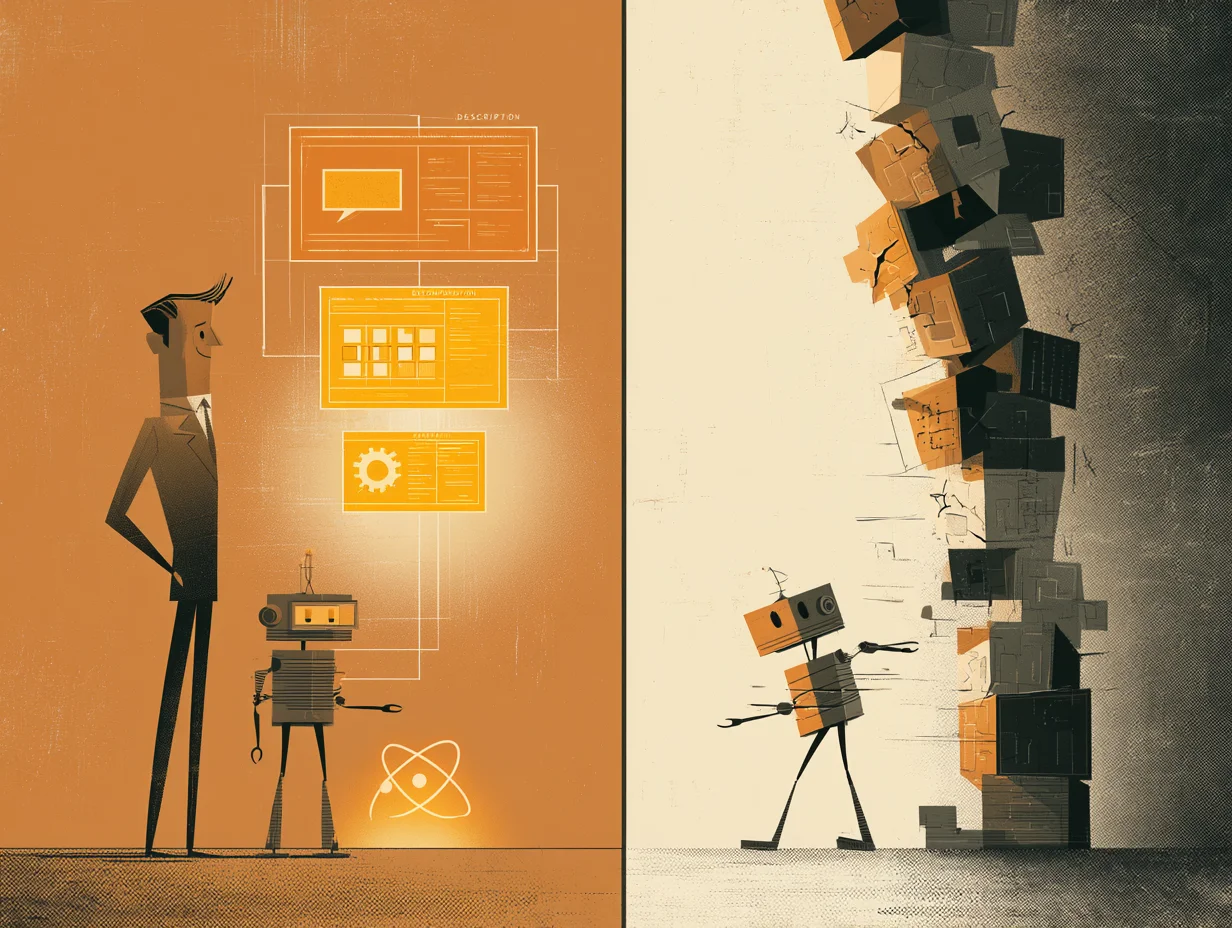
The Atomic AI framework applies here exactly as it applies to business process automation. The failure mode is identical: skip the description and decomposition phases, jump straight to generation, get output that looks right but breaks under any real conditions. Before a single line of code gets generated, a founder needs to be able to answer three questions in plain language. What does this feature do? What data goes in and what comes out? How would you know if it is working? If you cannot answer those three questions before opening Claude Code, you are asking the AI to make those decisions for you. It will. You will not always like what it decides.
Step one is description. Use AI as an interviewer before you use it as a builder. The prompt is not "build me a booking system." It is: "Help me describe exactly what a booking system needs to do for my specific business. Walk me through who uses it, what data it needs to store, what happens when a booking conflicts, what happens when a user cancels, and what a successful booking confirmation looks like end to end." That conversation, done entirely in plain language before any code exists, surfaces requirements you had not considered and edge cases that would have broken your first version. It is worth more than a week of generation.
Step two is decomposition and validation. Take the description and break it into the smallest meaningful units, each with a clear input, a clear output, and a success condition written in plain English. "When a user submits their email and a time slot, the system confirms the slot is available, reserves it, sends a confirmation email to the user, and adds the event to the business calendar. If the slot was taken in the last 30 seconds, the user sees an error and is shown the next available time." That success condition is your test case. It existed before any code. Now build a mockup, not code. Use Claude to generate a clickable interface that looks real enough to put in front of a user. Validate the idea. Change it. Throw it away if it does not work. Mockups cost nothing to discard. Bad code costs weeks to replace.
Step three is generation with intent. Now open Claude Code. You have a clear description, decomposed requirements, and test cases defined in plain English. Ask Claude to write the tests first, then the implementation. Ask it to explain the data model before generating the schema. Ask it to describe how two concurrent users would interact with the same resource before writing the concurrency logic. The output you get when you prompt from a position of understanding is categorically different from the output you get when you prompt from a position of hope. And because you defined what working looks like before you started, you can evaluate what you receive. You are not guessing. You are checking.
The actual competitive advantage of AI code generation for a non-technical founder is not cheap production code. It is cheap enough prototypes to validate ideas before committing to architecture. Build the prototype with Claude. Show it to users. If it validates, bring in an engineer to build the real version using the prototype as a specification. If it does not validate, you saved the cost of a full build. That is the genuine 1/10th cost advantage, and it is real. The founders who understand this are not pretending to be engineers. They are doing what great product people have always done: defining the problem with enough precision that the solution becomes obvious, then letting the right tool build it.
Topics
Want to see these systems in action?
Start with a conversation. We will walk through how these workflows apply to your business.
Get your AI Roadmap